
DESMO
THE PREMIER PLATFORM FOR AIRCRAFT
AND ON-BOARD SYSTEMS PRELIMINARY DESIGN
AND ON-BOARD SYSTEMS PRELIMINARY DESIGN
DESMO
THE PREMIER PLATFORM FOR AIRCRAFT
AND ON-BOARD SYSTEMS PRELIMINARY DESIGN
AND ON-BOARD SYSTEMS PRELIMINARY DESIGN
DESMO is a robust platform for aircraft and on-board systems preliminary design, enabling fast, adaptable, and defensible aircraft-level decisions across commercial, general aviation, UAV, VTOL, and military aircraft.
Modern aircraft concepts introduce tightly coupled interactions across disciplines and on-board systems that must be understood early. DESMO makes these interactions explicit, traceable, and consistent from the earliest design phases.
Why
DESMO?
Addressing modern aircraft complexity
Early-phase aircraft design is often driven by fragmented tools,
spreadsheets, or isolated scripts. While useful for single questions,
these approaches do not scale when configurations, missions,
or architectures change.
Classical methods also fail to capture the strong coupling
introduced by modern propulsion, advanced avionics, and
rising electrical and thermal demands — leading to early
decisions that are hard to adapt, hard to defend, and
disconnected from aircraft reality.
Preliminary design beyond sizing
Modern aircraft are shaped by tightly coupled systems,
not just weight and geometry.
DESMO goes beyond traditional sizing
by exposing system interactions and
aircraft-level trade-offs early in
preliminary design, enabling faster exploration
and more defensible decisions as concepts evolve.

Why multi-fidelity support matters
Early in an aircraft program, progress depends on abstractions and
estimation methods that work despite uncertainty.
Lightweight methods enable very fast computation, rapid iteration,
and broad design space exploration.
As knowledge improves, DESMO allows engineers to increase model
fidelity step by step, without breaking consistency or rebuilding
models from scratch.

Addressing modern aircraft complexity
Early-phase aircraft design is often driven by fragmented tools, spreadsheets, or isolated scripts. While useful for single questions, these approaches do not scale when configurations, missions, or architectures change.
Classical methods also fail to capture the strong coupling introduced by modern propulsion, advanced avionics, and rising electrical and thermal demands — leading to early decisions that are hard to adapt, hard to defend, and disconnected from aircraft reality.
Preliminary design beyond sizing
Modern aircraft are shaped by tightly coupled systems, not just weight and geometry.
DESMO goes beyond traditional sizing by exposing system interactions and aircraft-level trade-offs early in preliminary design, enabling faster exploration and more defensible decisions as concepts evolve.
Why multi-fidelity support matters
Early in an aircraft program, progress depends on abstractions and estimation methods that work despite uncertainty.
Lightweight methods enable very fast computation, rapid iteration, and broad design space exploration.
As knowledge improves, DESMO allows engineers to increase model fidelity step by step, without breaking consistency or rebuilding models from scratch.
Key Capabilities
Integrated aircraft and systems modeling
Model the aircraft and its on-board systems as one coherent system, capturing coupled effects across aerodynamics, structures, propulsion, stability & control, and energy systems.
Automatic propagation of impacts
Changes to configuration, mission, payload, or architecture propagate automatically across the aircraft model, enabling fast and consistent evaluation of mass, balance, performance, and system behavior.
Multi-disciplinary trade-offs and optimization
Explore and optimize aircraft concepts using integrated MDAO workflows, supporting rapid trade-off studies across configurations, missions, and technologies.
Support for next-generation architectures
Evaluate conventional and unconventional concepts, including hybrid, electric, hydrogen-powered, and defense aircraft with high power and thermal demands.
Defence
Aircraft
Mission and configuration complexity from day one
Modern defense aircraft are designed as multi-role platforms, required to support a wide range of missions, payloads, and configuration variants from the earliest design phases.
Configurable hardpoints, store variations, and mission-dependent loads introduce strong coupling effects across mass, center of gravity, aerodynamics, performance, stability, electrical power, and thermal management. Classical preliminary design approaches struggle to capture these interactions consistently and early — increasing program risk and rework later in development.
In addition, modern defense aircraft are increasingly equipped with advanced, power- and thermally demanding capabilities for surveillance, survivability, advanced flight control, and mission execution. These capabilities fundamentally influence aircraft sizing, energy management, and system architecture and therefore require consideration at the aircraft level already in the preliminary design phase.
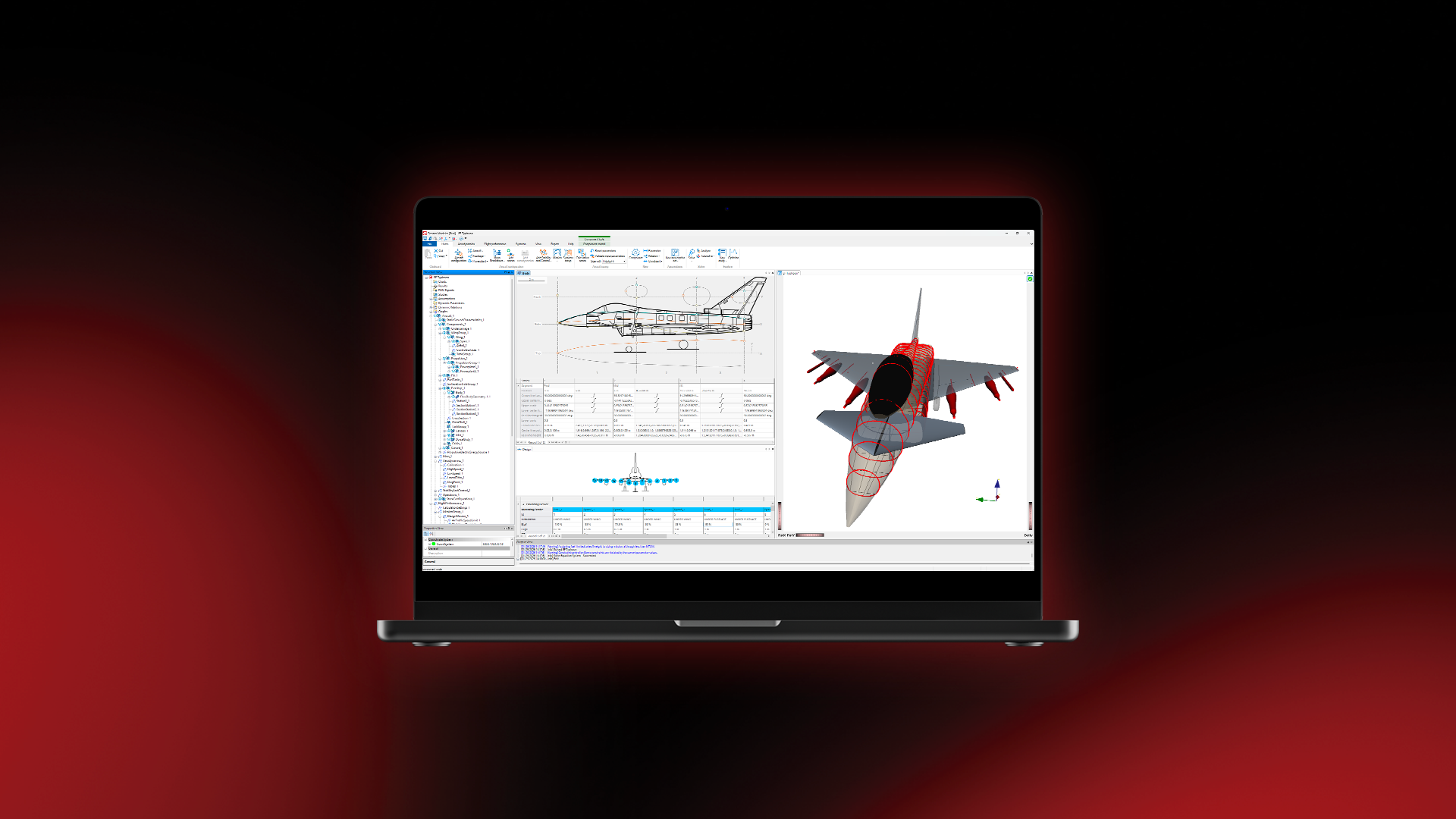
DESMO supports the definition and evaluation of complex military mission profiles and systematic variation of store and payload configurations. Aircraft-level impacts propagate automatically across the aircraft, enabling engineers to assess performance, balance, and system behavior coherently across multiple mission scenarios.
Key Benefits
No black boxes — full control
DESMO provides full transparency: all models and methods are delivered as source code, giving engineers complete control over assumptions, parameters, and calculations.
Using DESMO’s authoring environment, users can adapt, replace, or extend methods while preserving traceability, maintainability, and long-term usability.

Designed to integrate into your ecosystem
DESMO integrates with external engineering tools and supports model reuse downstream, including FMU-based co-simulation with high-fidelity analysis environments.
Full IP protection and offline operation
DESMO operates entirely offline. Models, methods, and custom code remain fully under your control, meeting the IP protection and security requirements of commercial and defense programs.